About
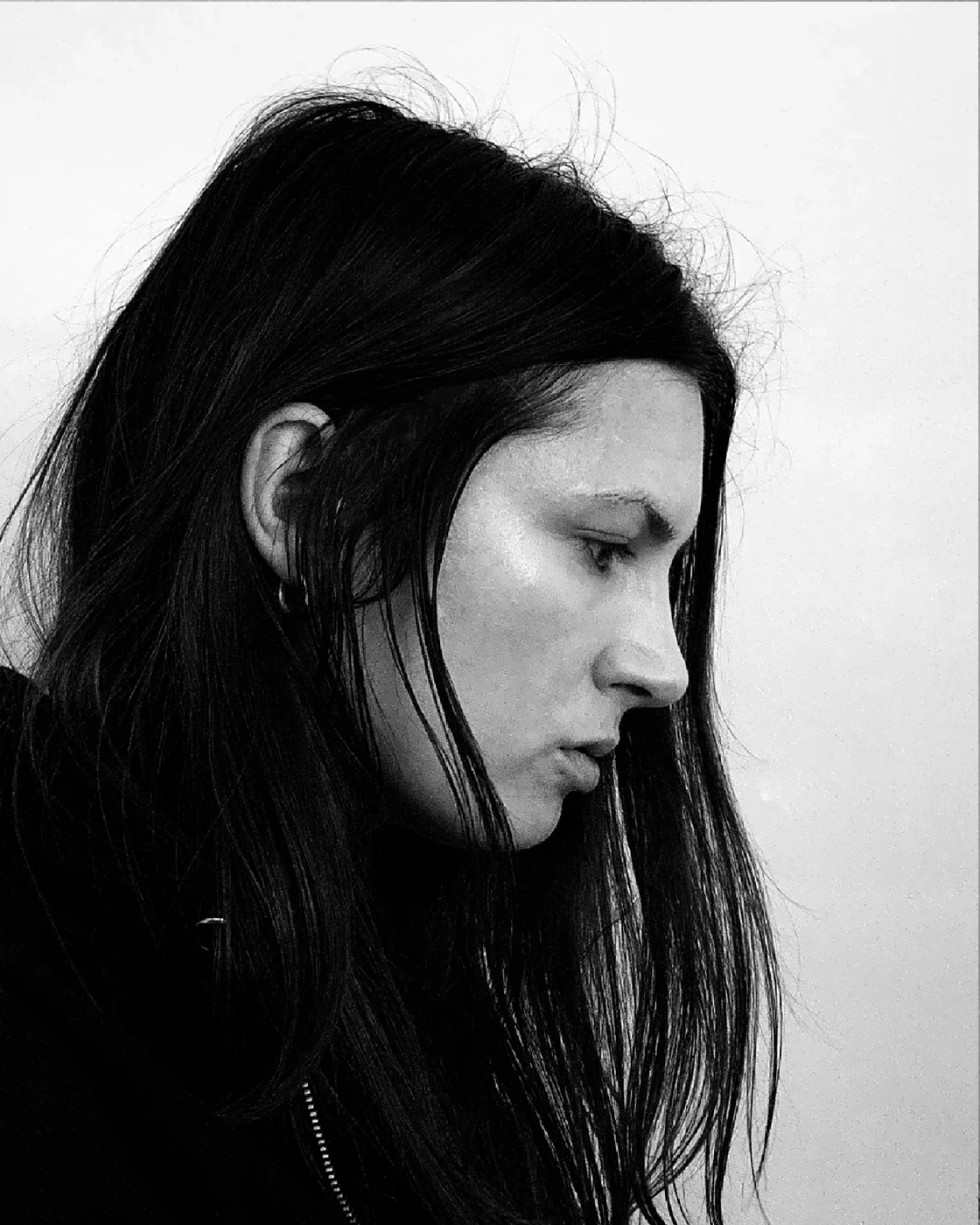
Pfishova is a Kashubian-Polish Contemporary Artist working in painting, assemblage, object and installation. A graduate of the Academy of Fine Arts in Gdańsk (Faculty of Graphics, 2014), she builds dense, monochrome works from reclaimed matter and the written sign. At the root of her practice is light-sensitivity: she perceives the world, and her own work, through it — the fullness of light and colour is something her body must constantly negotiate. Across every medium her practice circles one enquiry — the body, anxiety and the systems of control that shape how the body, the mind and the self are seen, measured and held — carried with a heightened sensitivity to melancholy and liminal, borderline states. What she buries in the work — a word, a wound, a body — refuses to disappear.
Artist statement
Pfishova works in painting, assemblage, object and installation, almost always with material that has already lived — reclaimed, cast off, salvaged. What interests her is what remains after use: after an object, after a person.
Colour, for her, is not a free choice. She is light-sensitive, and perceives the world — and her own work — through that sensitivity; the fullness of light and colour is something her body must constantly negotiate. Her work settles into a near-monochrome not as a rule imposed, but as the place where she sees and feels most clearly. In black, only texture, pressure and trace remain.
Her work circles a single enquiry: the body, anxiety, and the systems of control that decide how the body, the mind and the self are seen, measured and held. Language belongs to those systems — the written sign names, classifies and sentences — so the word enters the work as both material and evidence, set against the body it is meant to govern.
Beneath all of it runs an awareness of death, present since childhood: she grew up among post-mortem photographs — the old custom of photographing the dead, laid out and pasted into family albums beside the living, always in black and white. That early, matter-of-fact closeness to death — not morbid, but a ground to see from — shapes both her monochrome and her gaze. It surfaces earliest in her own photographs — bodies bound, salted, labelled — and returns, transformed, in the paintings, the nets, the cast and corked objects, carried with a heightened sensitivity to melancholy and to liminal, borderline states.
Some works turn outward: the Ghost Nets speak of entanglement — fishing nets abandoned at sea, and identity caught the same way. Others turn inward — the She paintings hold the female body and self under the very gaze that measures and names them. She does not separate the two; the system of control, in her work, often has two hands, and one of them is her own.
Education
2014 — Academy of Fine Arts in Gdańsk, Faculty of Graphics (Graphic Design). Diploma studios: Prof. Sławomir Witkowski and Dr Adam Świerżewski; painting studio of Prof. Maciej Świeszewski.
Lives and works in Wrocław, Poland